Car accidents are one of the leading cause of injuries in the country. Individuals are routinely involved in them on a daily basis, and the average person is involved in at last 1 car accident in his lifetime. Because of how large cars are and how fast they can travel, many collisions can lead to serious and lasting injuries. One of the less common forms of injury is thoracic outlet syndrome, which is essentially damage to the upper shoulder/clavicle region.
Contrary to many defense experts opinion that forces encountered in low-speed collisions are insufficient to cause serious injury, there is ample evidence in medical practice, backed by credible literature that indicates collisions at speeds as low as 10 km/hr can do much harm to the human body.
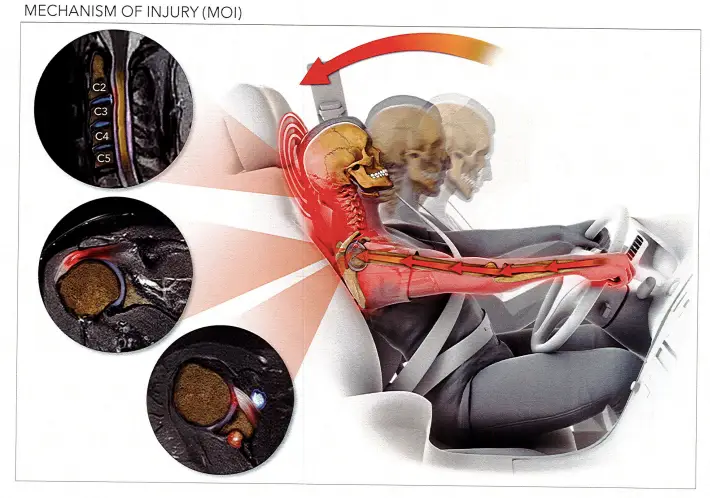
One such example involves the cause of Thoracic Outlet Syndrome (TOS). Medical literature notes TOS to be a combination of neck and/or shoulder trauma plus an anatomic predisposition.Neck or shoulder trauma, caused for example in auto crashes, as a causative factor of TOS resulted from observations reported by a few thousand patients whose symptoms of pain in their necks and arms, as well as numbness in their hands, developed soon after a motor vehicle crash. This observation was followed by studies that demonstrated significant cell changes in the neck and back muscles of patients with TOS.
What Is Thoracic Outlet Syndrome?
Thoracic outlet syndrome is the compression of nerves and blood vessels in the upper clavicle region that connects the thorax, trunk of the body, to the arm. Specifically, it affects the space between the clavicle (collarbone) and first, topmost rib. The thoracic outlet sits just in front of the shoulder and consists of the brachial plexus, subclavian artery, and subclavian vein. Therefore, when this group is compressed or impacted, it can cause the injury. There are numerous types of thoracic outlet syndrome; each type impacts a different part of the outlet. The most common form affects the brachial plexus, while the less common types affect the artery and vein. Thoracic outlet syndrome is characterized by pain in the immediate area and extension to the forelimbs. Your muscle in the base of your thumb may degenerate and become weaker over time, and your fingers and arm may grow numb or tingly. Your grip will thus weaken as well. There will be neck pain and arm pain accompanying the condition.
Congenital bands and ligaments are observed in a large majority of TOS patients. Several different kinds of bands have been recognized and categorized. These bands and ligaments are present at birth. In patients with TOS, they become associated with symptoms following trauma – even minor trauma. The anatomic findings are, therefore, usually regarded as a predisposing factor and not the causative agent.One would assume that if the site of pathology in TOS is the scalene (tiny muscles in the neck) muscles, there should be abnormalities found in them. In fact, findings of muscle scarring have been found and reported in the medical literature.
Based on the above observations, namely a history of neck or shoulder trauma with variations in normal anatomy & cell changes in scalene muscles, one can readily explain the pathophysiology of TOS. The underlying pathology in most patients is scarring of the scalene muscles caused by shoulder or neck injuries. The tight scalene muscles (due to scarring) causeneck pain and headaches, as well as temporomandibular joint (TMJ) symptoms, which usually develop within a few days of the crash. As scarring in the muscles develops, the muscles compress the brachial plexus (a network of nerves, running from the spine, through the neck, through the armpit region and into the arm). The compression elicits the symptoms of pain, numbness and weakness of the upper extremity.
What Are Symptoms Of Thoracic Outlet Syndrome?
There are a few ways that you can identify thoracic outlet syndrome. It is important that you accurately identify these symptoms, as a misdiagnosis can be devastating to your condition. You should not let any nerve-related or blood vessel-related injuries carry on too long. Symptoms include the following:
- Discoloration or a bluish hue in the hand on the same side as the pain
- Throbbing sensation in your collarbone or upper thorax
- A lump or tight band beneath the surface at your clavicle
- Arm pain, inflammation, and blood clots
- Arm weakness
- Neck muscle weakness, especially when turning
- Weak pulse or no pulse in the damaged arm
- Cold fingers and hand
- Quick fatigue of the arm and shoulder
The onset of extremity symptoms may be delayed a few days to weeks, and in some patients, even months – as it takes time for scar tissue to develop and compress. As the pathophysiology becomes established, scarring adds to the problem. These injuries set up a vicious cycle. Pain, bad posture, poor physical conditioning and anxiety then aggravate that cycle.
What Can Thoracic Outlet Syndrome Do To Your Body?
If left untreated, thoracic outlet syndrome can cause extreme shoulder damage and inability to move. It can also influence carpal tunnel syndrome, which occurs when the carpal nerve leading down the wrist is compressed or damaged. Nerve damage can eventually lead to a lack o feeling in the area or an inability to move. In some cases, the numbness is replaced by a burning sensation that does not recede.
In conclusion, the anatomic problems that lead to TOS are now well known and documented in the medical literature. They consist of congenital anomalies that are superimposed on some form of trauma – even trauma caused by low impact forces.
Let Us Know How We Can Help You
- Medical Summary Reports for Settlement Letters
- IME Observation & IME Rebuttal Reports
- Reports Answering Specific Medical Questions
- Standard of Care Reviews
- Liaison with Treating Doctors
- Help with Strategies to Promote Medical Theories
- Interpretation of Meaning, or lack thereof, of Medical Reports & Records
- Independent Record Reviews
- Assessment of Case Validity Regarding Medical Issues
- Referral to Expert Medical Witnesses
- Medical Research
- Facilitation of Communication with Clients, Families, Professionals and Service & Governmental Agencies
- Case Coordination
- Deposition & Trial Question Preparation
- Table-side Deposition & Trial Assistance **We’ve recently gotten a lot of feedback asking us to help with case coordination in cases valued at $30,000-$60,000. Typically, these cases require a few hours of our time and we often pick-up medical issues not previously recognized that can add value.** We have purposefully kept our fees low to allow you to have us review these cases at the outset of your representation while controlling your expenses.